Data Owner
Approves standards, thresholds and priorities; remains accountable for the business data domain.

Go beyond a definition. Follow a real Data Governance lesson from the core idea, through a visual model and a banking scenario, to the reasoning an exam question is testing.
Each chapter is designed to help you orient yourself, understand the relationships, apply the idea and recall the distinction under exam pressure.
Start with the purpose of the knowledge area and where it fits in the wider data-management discipline.
Use diagrams, role distinctions and structured explanations to connect the moving parts.
Translate the concept into a realistic business or banking situation.
Identify the verb, the decision right and the common distractor before choosing an answer.
Data Governance is the exercise of authority, control and shared decision-making over the management of data assets. It clarifies who has the right to decide, who is accountable, which policies apply and how disputes are resolved.
That distinction matters because a technically successful data activity can still fail as an enterprise practice if no one has the authority to set standards, resolve ownership disputes or enforce common rules.
In the DAMA-DMBOK wheel, Data Governance sits at the centre. It provides policy, roles, decision rights and escalation across the other knowledge areas. It does not replace those disciplines; it gives them an accountable operating framework.
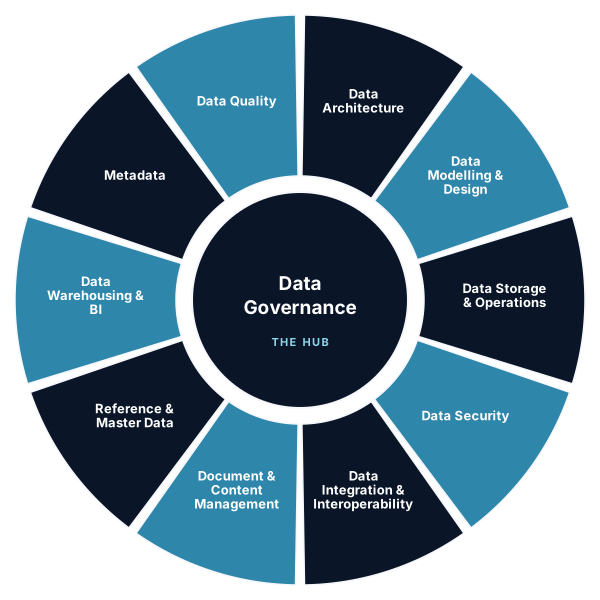
A chapter diagram, restyled with the companion's navy, blue and white palette. The hub is Data Governance; the surrounding disciplines operate within its policy and decision framework.
The exam often describes an action and asks which role should perform it. The reliable way through is to identify whether the action is about accountability, day-to-day business responsibility or technical operation.
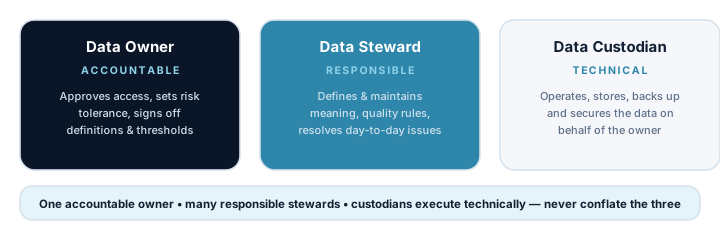
The chapter's role diagram: accountable business ownership, responsible operational stewardship and technical custody are distinct but connected.
Approves standards, thresholds and priorities; remains accountable for the business data domain.
Defines and maintains business rules, monitors quality and coordinates day-to-day issue resolution.
Operates and secures the platform that stores and processes the data, including technical access and backup controls.
Retail Banking and Wealth Management use different definitions of “active customer”. The difference affects a group-level regulatory report. The data stewards have documented both definitions, but neither domain will accept the other's position.
What happens next? This is no longer a routine glossary-maintenance task. It is a cross-domain decision-rights issue that needs governance escalation. The appropriate governance body arbitrates; accountable data owners approve the outcome; stewards update and operationalise the agreed definition.
Scenario questions often contain several plausible roles. Ignore job titles at first and classify the verb:
A data steward identifies that a proposed customer-risk threshold would materially change the bank's risk appetite. Which action is most appropriate?
This public lesson is an introduction to the approach. The companion's chapter goes further into the framework, operating models, policy hierarchy, governance bodies, common traps and revision.
From governance foundations and roles to councils, federated models and policy architecture.
Learn what the question is testing, why tempting alternatives are wrong and which distinctions to retain.
Consolidate critical definitions, role distinctions, policy sequences and last-mile reminders.
Independent CDMP preparation material. This demonstration is not official DAMA exam content and Data Shawarma is not affiliated with or endorsed by DAMA International.